What questions do you want me to ask?

I was talking to a friend recently, and asking what other questions I should ask on the site, and he said, “Hey, why not ask what questions people want to answer?” I thought, “Hey!” So here we are. :)

Q: What questions would be most fun for Friday questions?! What questions would you have most fun answering?

My answers:
* What’s the coolest experience you’ve ever had?
* What’s the thing you’re most proud of having done in elementary school?
* Describe your best friend from when you were growing up.
* What are some of the most beautiful things or places you’ve ever seen?
* What’s the most unusual feeling you’ve ever had?

Thanks! Really looking forward to reading your thoughts about questions that you want to be asked!

———-
Each Friday, I post a question. I would love it if you feel like answering the question! Thanks. (I’m a big fan of privacy also, so if you don’t want to use your name, just use an initial or just write “anonymous,” and if you don’t want to put your email address for privacy reasons, just put mine – it’s at the link ‘email me’ above.)

Fri (Aug 11) Josh Ritter on Conan

Speaking of self-assurance in a musician…

One of my favorite musicians, the young and experienced way beyond his years Josh Ritter, is appearing on the Conan O’Brien show on Friday. This is Josh’s first national TV appearance. About 2.5 million people will see him. Here’s Josh’s bio. I highly recommend his CDs.

Time and Place: NBC. Just past midnight on Friday night, Aug 11 (as it becomes Saturday). 12:35am.

Self-Assurance

A good conscience is a continual Christmas.
~ Benjamin Franklin

Trust yourself. Create the kind of self that you will be happy to live with all your life. Make the most of yourself by fanning the tiny, inner sparks of possibility into flames of achievement.
~ Golda Meir

Believe in yourself! Have faith in your abilities! Without a humble but reasonable confidence in your own powers you cannot be successful or happy…. Formulate and stamp indelibly on your mind a mental picture of yourself as succeeding. Hold this picture tenaciously. Never permit it to fade. Your mind will seek to develop the picture … Do not build obstacles in your imagination … Do not be awestruck by other people and try to copy them. Nobody can be you as efficiently as you can.
~ Norman Vincent Peale

Proverbs:
* Self-confidence is the memory of success.
* Self-assurance is two-thirds of success.

Your chances of success in any undertaking can always be measured by your belief in yourself.
~ Robert Collier

Self-confidence is the first requisite to great undertakings.
~ Samuel Johnson

Self-trust is the first secret of success.
~ Ralph Waldo Emerson

One important key to success is self-confidence. An important key to self-confidence is preparation.
~ Arthur Ashe

I think self-awareness is probably the most important thing towards being a champion.
~ Billie Jean King

Self-assurance. Being aligned with yourself. Some people describe this as authenticity. You see this when you see a performer on stage who appears casual, who appears to have a very easy rapport with the audience – whether a pop performer or a folk musician or a comedian. It’s a lightness. And I so believe in life being light and being easy.

Consistency

Two Ways
There are two ways to live life:
1) like a fast lottery ticket – by having one-time-payoff goals and going after them, and
2) like a squirrel gathering for the winter – by surely and consistently going after your plans.

Here are some arguments for the benefits of consistency. Sure, the lottery ticket is a draw – it is exciting, it is potential, and it can be huge! The squirrel, however, will always make her nest for the winter.

The Lottery Ticket. A friend of mine is a film reviewer. (I love dance movies: you name me a dance movie, and I’ve probably seen it!) My film-reviewer friend and I were talking about dance movies recently, and he said, “Senia, doesn’t it seem that most dance movies give the performer one chance or one performance or one try-out, and that that is the one that counts? And that things better be right for that one dance because it’s the one big chance?” And I thought about it, and he’s right – typically, dance movies are structured towards one dance or one night or one show or one try-out. It’s the lottery ticket – it’s the one chance to get things right. It’s what everything in your past training as a dancer has been moving you towards.
So you give it your all. And that’s the right thing to do. But it’s so hard to live life that way, anticipating one big hit every several years, and other than that, barely eeking by. It’s possible, but so hard. As Hugh MacLeod says (via Dave Seah’s post), “If your biz plan depends on you suddenly being “discovered” by some big shot, your plan will probably fail.” Living the lottery ticket is looking for big breaks all the time – looking for the job in which in a couple of years you can make enough money to retire, looking for the business contact that will bring in the company’s annual revenue for the entire year in January, looking for the book publisher who’ll love your idea for a novel and want to make it into a major motion picture.

The Squirrel. On the other hand, “slightly, lightly, and politely,” as I once heard a guy say at a dance club, the squirrel gets things done. She knows that she doesn’t have all summer to play, and so she builds and gathers for the winter. And the squirrel may be able to get even more things done while she rushes with the winter preparations. Yes, the lottery ticket is exciting. At the same time, a lottery ticket may not pay the bills. And if it does take 10 years to become successful at something, or if it takes 10,000 hours, then YES, start now, and consistently work at it. Just like after college, in your first job, some folks show you the benefits of investing early into a retirement account – that it is the amounts you put in earlier that reap the greatest gains later – just like that, the consistent attention to your chosen activity reaps the greatest gain from consistency. Just ask anyone who plays an instrument. Putting it down for a year definitely moves you back a bit.

There are two brief stories that illustrate the squirrel’s deliberate life of consistency:

The Fisherman
The story goes that a business school student was on his spring break in a small fishing village, and saw one fisherman who seemed to be more efficient than all the other fishermen. He watched him day after day, and just before returning to school, he approached the fisherman and said, “I’ve been watching you, and your catch is larger than all the other fishermen. I think if I help you out, we could get a few more boats out here, and you could train me and my friends, and we could make a lot of money very fast, and then, just think, you could retire very soon.” The fisherman just looked at him. And the business school student continued, “Just think, if you could retire, what would you do?” And the fisherman replied, “I would fish.”

“Sew a Little at Night”
There was a man who was the main tailor to the king, but one day a genie came to him and told the man that he would now be rich beyond all his beliefs, and the king would let him go as his servant because the king would have a tailor who could do things magically for the king, and that the man was free to go and enjoy his life. The man thought that was fine. Then the genie asked him, “What will you do all the day long now that you don’t have any cares and now that you have all the money that you want?” The man answered that he would live a relaxed life during the day, including walking, reading, eating, and then, he added, “I would sew a little at night.”

It’s what he does well – he would “sew a little.” Plus, even at that point, a little more money wouldn’t hurt. Of course, both these tales are exaggerated tales that show two things: the benefit of doing what you like to do and the benefit of consistency. I bet you would argue with me, “Well, Senia, why wouldn’t I want to do both? Shoot for the lottery and keep consistently improving at what I’m doing?” Actually, YOU WOULD! That would be the ideal!

DO BOTH – Shoot for the Moon and Keep the Day Job
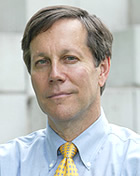
Dana Gioia One of my heroes in this sense is Dana Gioia (pronounced “JOY-a”). Dana Gioia has a Stanford MBA and worked for General Foods for 15 years, becoming a Vice President. Currently, he heads the National Endowment for the Arts, and here is his bio on the NEA site.

For years, Dana Gioia did both – published poetry books and worked a corporate job. I find that wonderful and incredible and inspiring. That’s the whole point. That’s what Hugh MacLeod means by “Keep your day job” and “Put the hours in.”

Dana Gioia has been masterful on two levels – at work with a corporate managerial role and in his spare time with poetry. That’s incredible! That’s like a story I heard from my friend that you are what you do in your spare time. If you consistently work at a hobby (or work more at your job like most entrepreneurs) in your spare time, you will be good at it. You will be good – whether it’s guitar-playing or rock-climbing or golf or running or writing. Whatever you consistently do, you will be good at. There are other ways to push yourself to improve at your chosen activity (through incremental challenges, asking raw questions, etc.), but you are already good at it if you do it consistently.

I heard once that John Grisham wrote his first few legal thrillers by getting to his law firm at 5am and writing from 5 to 8am. That is consistency. That is perseverance.

“Perseverance is a great element of success. If you only knock long enough and loud enough at the gate, you are sure to wake up somebody.”
~ Henry Wadsworth Longfellow

You are sure to wake up somebody. Like the little squirrel who finishes all her preparations for the winter, and then goes to the store to buy a lottery ticket … just in case. Although her affairs are in order, she thinks, “Why not?”
“Are Elephants Like Dinosaurs?”

“Mommy, are elephants like dinosaurs?” asked the little boy.
“Well…what do you mean?” questioned his Mommy.

“If the dinosaurs went extinct, then aren’t there some animals that came from what the dinosaurs used to be like?”
“You mean, ‘Are there some animals that are descended from dinosaurs?’ ”
“Yes, I think. What does “descended” mean?”
“It means animals that were born from animals that were born from animals that were originally dinosaurs.”

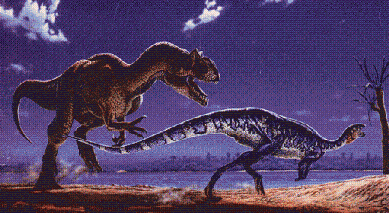
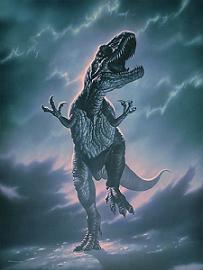
Theropod “Yes, are elephants descended from dinosaurs, Mommy?”

“Well, people don’t say that elephants are descended from dinosaurs, but there are creatures that you know that people say are descended from dinosaurs. Want a clue?” asked his Mommy.

“Yes, tell me.”

“Well, this is an animal that you might think is fast and can sometimes look like a small dinosaur or like a small dragon. Usually this animal has an interesting skin. The skin could be a puffy material or even more rarely scaly like an alligator. And the animal walks on short legs. This animal also comes in many, many colors.”

He thought for a moment, and said, “Alligators?” Then immediately, “Lizards?!”
“Well, people say that lizards and dinosaurs were not related even though they looked very similar to each other,” said his Mommy.
“Well, but how about an elephant? Elephants are big, they walk with very loud footsteps, and they have that interesting skin you talk about, right? Are elephants like dinosaurs?” he asked again.

“‘They’re not exactly like dinosaurs. How about something smaller?” asked his Mommy.
“But how could something smaller be descendable from dinosaurs?”
“Descended from dinosaurs,” said his Mommy.
“Descended from dinosaurs,” he repeated.
“Well, what dinosaurs do you know?”
“I know the bronotsaurus who is huge and eats only plants, and I know the TRex, who eats animals.”

“What about those theropods that look like the TRex?” asked his Mommy.
“The ones that are big and eat animals?” asked the boy.
“Yes.”
“Ok,” said the boy.
“Imagine those smaller,” said his Mommy.
“Ok,” said the boy.
Theropod

“What do they look like?” asked his Mommy.
“Like small dinosaurs,” said the boy.
“And how would they have moved?”
“Fast, like they didn’t like running, but still like they could run,” said the boy.
“Ok, what else moves fast on the ground?”

Pelican “Well, that’s funny! Dogs can move fast, and birds that aren’t flying can move fast.”
“Ok, so let’s think about birds,” said his Mommy.
“Ok.”
“They’re fast?”
“Yes.”
“They are shaped like small dinosaurs when they stand on the ground?” asked his Mommy.
“Yes.”
“Could birds be descended from dinosaurs?”

“Maybe…” the boy thought for a moment, “but that’s weird.”
“Ok, it’s weird, but could it have happened?” asked his Mommy.
“Yes… a bird is a small dinosaur?”
“I’m not sure that it’s actually a small dinosaur, but it may be descended from a dinosaur!”

“So not elephants… but yes birds?… That’s good: when I see a bird, I can think of a dinosaur,” decided the boy happily.

Chess – IMing with a Bot

Because I recently wrote about expertise being trainable with a major component of the article I referenced being about chess, I want to show you this: David Cowan writes a hilarious post about playing chess online and the im-bots that attempt to simulate a teenage girl on the online chess site. Here’s a segment from his blog:

Unlike other AI engines, the Yahoo! bots do not even incorporate the human being’s questions into their responses. Rather, they exploit the disjointed nature and shallow personae of adolescent chat to spoof a teenage girl, as demonstrated by these pearls of wisdom recently quoted–typos and all–from A_busty_babe_cc_32 (interjected with comments from armandolinares001, a naive suitor):

can any guys beat me?
you play good
19/f bored with pics in profile
can i see?
Hi… 19/f :-) Pics in my profile
do you have a profile?
oOOooOooo
yeah, in my profile
ohh
armandolinares001: hi
tee hee
armandolinares001: wat?
are you married?
armandolinares001: no u?
I love cheesy poofs
you play good
19?F/Cali web cam and pics in my profile!
I’m feelin gfrisky
lolol
thats hot

See David’s full post here.

What makes you feel most alive?

What makes me feel most alive?

On My Own:
* Lounging. When time stands still. When you’re lazily doing nothing and enjoying yourself immensely – usually after work or on a weekend. Just lying on your back on a picnic table in the local park, looking up at the moving clouds. Just being outside in nature without even necessarily moving, lounging as time goes by.
* Pushing myself in sports. Running. Swimming. To total exertion – talk about “alive!”
* Getting past a challenge. Daring myself and then doing it. (Like the ideas in The Game of Work – just setting new metrics to get better at. Or doing something risky – like making an announcement in a crowded train.)

With People:
* Debating and Story-telling. My really good friend says that the two times time when people are most alive are when they are debating something with each other (because then their brains have to be active, have to be engaged in the back-and-forth), and when they’re telling stories (because then their brains are actively reliving those stories).
* SPORTS! Rock climbing. Hoops. Volleyball. Hiking. Rollerblading.
* Outdoorness. Even separately from sports, being outside – hiking, rock climbing, running into the cold east-coast ocean on July 4.
* Finishing a project. For work or with classmates. This is such a good feeling.
* Just lounging with people you really like. Nothing is sometimes a very, very good activity.

I feel like I am a delineating the different activities even a little too much. All I really mean to say is that activities that push me make me feel the most alive! (Many would call that flow.) And activities that quiet me also make me feel most alive. Push me and quiet me. :)


What makes you feel most alive?


On Fridays, I post questions because I love questions. I would love it if you feel like answering the questions! Thanks. (I’m a big fan of privacy also, so if you don’t want to put your name in, just use an initial or just fill in the letter “A” and we’ll know it’s anonymous, and if you don’t want to put your email address for privacy reasons, just put mine – it’s at the link ‘email me’ above.)

First, You Copy

What did Willa Cather do when she wanted to become a great writer? She took Henry James’ books and she copied entire sections, entire sentences from them. She felt the music of each sentence, and its richness, and the fall of the words. Then, Willa Cather wrote many stories in Henry James’ literary style. And then she wrote her own stories and novels.

First, you copy.

Alex Ross describes Mozart’s early work in music in this issue of the New Yorker in an article called “The Storm of Style.” Between the ages of eight and ten, Ross writes, “Young Mozart shows an uncanny ability to mimic the styles and forms of the day: Baroque sacred music, opera buffa, and opera seria, Gluckian reform opera, Haydn’s classicism, the Mannhein symphonic school, Strum und Drang agitation, and so on.”

This is the 10,000 hours of practice, practice, practice (some of which is copy, copy, copy) that I mentioned here.

Ross continues, “Hearing so many premonitions of future masterpieces, I got the feeling that Mozart’s brain contained an array of musical archetypes that were connected to particular dramatic situations or emotional states—figures connoting vengeance, reconciliation, longing, and so on. One example appears in “La Finta Semplice,” the merry little opera buffa that Mozart wrote when he was twelve. In the finale, when all misunderstandings are resolved, there is a passage marked “un poco Adagio,” in which Giacinta and her maid Ninetta ask forgiveness for an elaborate ruse that they have pulled on Giacinta’s brothers. “Perdono,” they sing—“Forgive.” Not just the words but the music prefigures the tremendous final scene of “The Marriage of Figaro,” in which the wayward Count asks the Countess’s forgiveness—“Contessa, perdono!”—and she grants it, in a half-hopeful, half-heartbroken phrase. I looked at the New Mozart Edition scores side by side, and noticed that the two passages not only waver between the same happy-sad chords (G major and E minor) but pivot on the same rising bass line (B-C-D-E). It is unlikely that Mozart thought back to “La Finta Semplice” when he composed “Figaro,” but the idea of forgiveness apparently triggered certain sounds in his mind.”

Programmer and writer Paul Graham says, don’t copy things mindlessly: copy what you like. He points out that it’s very important to copy those things that you like and not those in fashion to copy or those that it may be useful or good for you to copy. Plus, he says, when you copy, copy the good things about the item, not the bad things (such as when artists used to draw with a brownish haze to copy Rembrant’s colorings that just made paintings look a little muddier).