Thursday July 26, 2007
In coaching, I often think about how to ask a person questions so that I can understand more of his world. Sometimes it feels as if there are not enough details, or I don’t quite see a situation from her point of view.
In this case, it’s natural to want to ask, “Is there anything more you can tell me?”
But that question is often a dead-end because to a degree it presupposes that, um, no, there’s not anything more that the person can tell me. “Well is there any other way that you could structure your day so that you have healthier food around you?” Um, no, not really, I’m already doing everything I can think of.
Try this question:
“What is some other way that you could structure your day so that you have healthier food around you?”
What did I do differently here?
1) I made it an open-ended question. “What is some way …?” as opposed to “Is there …?”
2) I asked about some way as opposed to any way.
I know this sounds silly - it’s just ONE WORD. On the other hand, you unburden the word by making it open: SOME vs. ANY. You put a new pre-supposition in there. The assumption is that there is some way. Or perhaps together we could think of some way.
“What are some new ways that we could approach this company and this department if you want a job here?”
“Well, I’ve already talked to my contacts there, and I’ve approached the person who has the same responsibilities as me.”
“What might be some other ways?”
“Well, I could contact someone else.”
“Great, who might be some other people that you could contact? What might their roles be? What might they be involved with at the company?”
The openness of “some” and of open-ended “what” questions can move you closer to something true that leads to action. Enjoy!

Where does the term “degugging” come from?
Welcome to Quote Thursdays. Is this below quote familiar to you?
“A ship in port is safe, but that’s not what ships are built for.”
~ Grace Murray Hopper
This is Admiral Grace Murray Hopper,who is described in a quote bio as “the American computer pioneer, was the first woman to become a Distinguished Fellow of the British Computer Society. She was born in 1906 in New York. By age seven, she was taking alarm clocks apart to see how they worked. She worked for the U.S. Navy developing the first compiler, which allowed people to write computer programs in real language rather than machine code. When she found a moth inside a computer, she coined the term “debugging.” She died in 1992.”
I earlier described what I mean by a quote bio here. Wikipedia backs up this history of the origin of “debugging,” although adding that in non-computer circles such as aeronautics the term had had some popularity prior to Hopper.
Tuesday July 24, 2007
Barry Schwartz says two things are the most important in life:
1) Knowing generally what you want to do (do you want to be a pilot or a doctor? a businessperson or an actor?), and
2) Knowing that ALMOST GOOD ENOUGH is usually GOOD ENOUGH.
If you generally know what you want and you move forward with things that are along your trajectory and moving you in the right direction, Barry Schwartz would argue that these two ideas will move you most effectively towards your goals.
As Paul Rozin says, “Happiness is all about expectations management.” And by knowing what you want, and that you are constantly moving forward in incremental steps, you do get closer!
Friday July 20, 2007
We wrote before about the interview question that you may most dread, and there were some great comments there that we’ll go back to in future posts.
What is the question you consistently ace in interviews?!!?
And what are some of the ways that you address the question successfully?
Wednesday July 18, 2007
At its best, “delegate” becomes “put people in charge!”
Managers often get very excited to “delegate,” and to get rid of boring responsisbilities. “Oh, when I hire this associate person, I can delegate all my planning to him or delegate all my morning market analysis to her.” Yes, sometimes the job that you have set aside for that person will free you fo exactly the things that you may least want to do.
On the other hand, sometimes you’ll need to delegate away exciting responsibilities to open yourself up to do more. It’s not always the boring chores that you delegate away, sometimes its just those that other people can do best for you.
A positive way to looking at “delegating” is “putting people in charge” - what can you put people in charge of most effectively? What can you be sure that someone will be proud to run as a process?
And people are different! What one person will love running another would be horrified to be anywhere near. So, have fun with the balance of it all!
Thursday July 12, 2007
Do not be too timid and squeamish about your actions. All life is an experiment.
~ Ralph Waldo Emerson
If that’s true, then you should jump into the experiments… so double up on courage, and treat all of life as an experiment…
Courage is rightly esteemed the first of human qualities… because it is the quality which guarantees all others.
~ Winston Churchill
And once you have that courage, get EVEN MORE COURAGEOUS because you’ve got nothing to lose by flaunting it all …
Don’t be so humble, you’re not that great.
~ Golda Meir
Happiness is when what you think, what you say, and what you do are in harmony.
~ Mohandas Gandhi
Monday July 9, 2007
This Expectations post is my second-favorite Seth Godin post so far this year. This still remains my favorite this year so far.
It’s a pretty short post, so here it is in its entirety:
Expectations
Word of mouth comes directly from expectations.
Low expectations are a terrific shortcut, because when you exceed them, people are so amazed that they can’t help but talk about it.
But low expectations are dangerous, because if you fly too low, you’re invisible. Worse, when people expect little of you, they often don’t bother listening at all.
So most of the time, you’re challenged with this: high expectations that must be beat.
Broadway shows. Apple products. Expensive consulting services. Promise big and deliver bigger seems to be the only reliable strategy.
Yes! This is in a sense what Seth’s book is about - The Dip. Be the best - challenge all expectations and be the best at what you’re doing, and get rewarded at that level for it.
I agree. I believe. I know.
Friday July 6, 2007
This is one of my three favorite holidays.
It is a love story in Japan.
If you make a wish on this day, and if it does not rain, then your wish will come true! This year it is especially lucky because it is the seventh day of the seventh month of the seventh year.
Here’s the story as I wrote about it last year. It is a colorful, wildly fun holiday, and I wish I were in Japan this year for this holiday!

(Images from here).
THE TWO STARS:
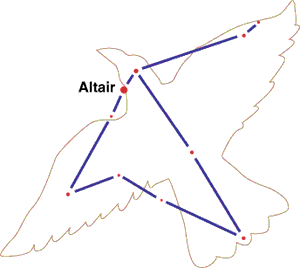
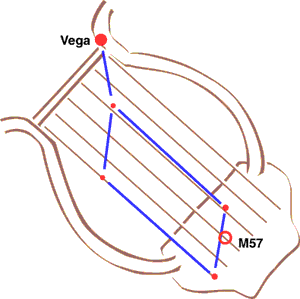
Tanabata means “Festival of the stars.” This is a story about the two stars Altair (the boy) and Vega (the girl) which are the main stars in two constellations, Aquila the eagle and Lyra the musical lyre:

Altair and Vega are also two of the three stars of the
Summer Triangle, and appear closest to each other in the summertime. (Images from
here and
here).
THE LOVE STORY:
There was a girl named Orihime - she was the daughter of the Sky God and she wove beautiful weavings. One day, she looked out of her window and saw the oxen-boy, Hikoboshi, and they fell in love. They spent so much time together that she didn’t have any time to weave, and so the Sky God separated the two, and allowed them to only meet each other on the seventh of the seventh.
Why is the Milky Way involved? “In the Chinese Calender, there is almost always a half moon on July 7th and they believe ORIHIME and [HIKOBOSHI] use that half moon as a boat to meet each other over the great river in the sky, AMANOGAWA [the Milky Way],” reports this site.
YOUR ROLE:
As long as the Milky Way does not overflow, everyone’s wish will come true on this day. So you can put on your bright summer cotton kimono, called the “yukata,” and you can go dancing in the parks, and you can write your wishes on brightly colored paper (as Dave describes here!) and tie them to a plant (in Japan, it would be a bamboo tree). And finally, you make that wish wholly and deliberately, and then you let go….
Tanabata is a really fun holiday. What will you write down on bright, colored paper ribbons to tie to the trees?
Toss your answers in the comments please, and enjoy the weekend!
Best,
Senia