Q FRI: How would you write your quote bio?

Hi, Welcome to Question Friday. I receive daily quotes by email, and below the quote, there is a brief summary of the person’s life.

It’s not easy to summarize our own bios from five sentences to one or two, and here, whole lives are summarized and in a wonderful way too! If you were writing the bio to appear underneath some of your quotes, what would you want the quote bio to say?

Q: How would you write your quote bio?

Here are some examples, and my italics of some great phrases in them:

About Richard Bach
Richard Bach, the American pilot and author, became hugely successful with the publication of the slim novel Jonathan Livingston Seagull a spiritual quest about a bird who loved to fly rather than seeing flight as a means to an end. He was born in Illinois in 1936, a descendant of composer Johann Sebastian Bach. He has been an Air Force Reserve pilot, a flight instructor, and a barnstormer; most of his books involve flight either directly or as a metaphor.

About Tennessee Williams
Tennessee Williams was the pen name of Thomas Lanier Williams, the multiple-award-winning Southern Gothic playwright best known for his plays Streetcar Named Desire and The Glass Menagerie. He was born in 1911 in Mississippi, where he had a difficult childhood with an abusive father, a smothering mother, and a schizophrenic sister. His emotionally honest plays often feature sensitive souls who don’t fit into a confining culture. He spent most of his adult life in New York City. He died in 1983.

About Virginia Satir
American psychotherapist Virginia Satir played a central role in shaping family therapy. She was born in Wisconsin in 1916. While working as a teacher, she became deeply involved in the lives of her students and their parents. This led to graduate school and a career change. She took on the mission of inspiring therapists to work with families. She cofounded the Mental Health Research Institute in California, where she held the first-ever family-therapy training program. She died in 1988.

What’s your quote bio?!
BTW, do not be intimidated by the fact that these bios above are of well-known people. Write yours as just that – yours!
p.s. Brag! :)

Best,
Senia

Nick-isms: “I don’t spend my energy in battle.”

“You can’t get anyone to change unless they want to.”

“What’s the point of picking an argument? I’ll still have my views and you’ll still have yours.”

“People who push someone to do something usually just wish someone would push them instead.”

“Forgiveness is the lynchpin of humanity.”

“I don’t spend my energy in battle.”

Margaret-isms: “Get it out the door”

A colleague of mine from the MAPP program, Margaret Greenberg, is an executive coach and runs a organizational effectiveness consulting practice. She says some absolutely wonderful things! Margaret emphasizes fulfillment and balance in working with individuals and teams. I am big fan of Margaret’s action-based approaches. Some of my favorites of her quotes:

On concrete tasks:

“What’s the point of spending hours on something until you know what the value of it will be?”

On finishing projects and sending them off for comments:

“Get it out the door!”

And others:

“Start with WHO and WHAT you know.”

“We’re human beings, not human doings.”

Update: More Margaret-isms! (4-5-07)

* Our lives go in the direction we tell ourselves.
* What if it were easy?
* Do what you love and you’ll never work a day in your life.

* When all is said and done, more is said than done.
* What would your future self, you 20 years from now, have to say about that?

Sam Bayer-isms: “More than ‘All the world’s a stage'”

Sam Bayer is one of my favorite singer-songwriters. He is one of those rare immediately-caring people that you recognize as soon as he sings a song or talks with you outside the music hall. Sam Bayer writes in his latest newsletter about the roles people play:

Goffman was a brilliant sociologist, and one of his most influential books is The Presentation of Self in Everyday Life, which can be summed up, pretty succinctly, by mutilating Shakespeare: not only is all the world a stage, but every situation is a performance, and the roles we assume vary according to which play we happen to be in at the time. I think of Goffman a lot; we’re different people to our friends than we are to our coworkers, or our parents, or our spouses, or our children.

Sam is in particular speaking about how we have different roles as a musician and as a host. The audience learns just a few things about you while you’re on stage. Sam writes:

Some people believe that there’s really no room for more than three basic facts about a solo performer: e.g., you’re tall, you’re a cross-dresser, and you used to be a Marine. The other details are just noise; they detract from the focus of the performance. A while back, I settled on three words: Literate. Resonant. Exuberant. They’re on the top of each page of my Web site. They’re the three things I want people to remember about me, and my performance, when they leave.

If you have a chance to see Sam Bayer perform, DO!
Sam also hosts the definitive lists of Boston “open mikes” on his site.

How to Make the Most of a Conference

  1. Have Fun.
  2. Be in the Moment.
  3. ASK!
  4. Take Risks.
  5. Go to the Panels you Want to Go To.
  6. Talk to Those People You Want to Talk To.
  7. Forget the Sales.
  8. INTRODUCE PEOPLE TO EACH OTHER!
  9. Send an Email Later that Night.
  10. HAVE FUN!!!!!!!

1) Have Fun. Everyone wants to be around someone who is having fun. Have fun – enjoy the people you are speaking to, enjoy the talks you are listening to.

2) Be in the Moment.
At conferences, it can be easy to be distracted and look around. But you’re not doing yourself any favors. If you’re speaking to someone and you’re looking around to see when the speakers from the last panel will come out so that you can say Hi to one of the speakers, the person you’re speaking to will not have a great experience, and you won’t have a great experience. In this case, the grass is not always greener. Solutions? Wait patiently if you’re waiting, and if you’re speaking to someone, give that person your full attention. It is much better to excuse yourself in advance, “Great to meet you, I’m going to go wait for someone right now,” than to be absentminded and preoccupied when speaking with someone.

3) ASK!
This is maybe the most important point. Ask questions. There is no such thing as a dumb question, or anaive question. Ask. You may be in a different field than another person. You may be used to different jargon. Ask. Have fun with asking questions. Be genuinely curious. Asking is fun.

4) Take Risks.
Do it! Just do it! If someone spoke on a panel, and you’d just love to say Hi, or ask something, JUST GO UP TO THAT PERSON. At a conference, everything is fair game. People are friendly. Take a social risk, and just do it. If you don’t tend to enjoy being extroverted, just act it for a few moments, and talk to whom you want to talk to. Remember The More, The More: the more you practice going up to people you want to speak to, the better you’ll be at this.

5) Go to the Panels you Want to Go To.
Every time you think, “let’s do this because I should,” you’re telling your brain, “I am willing to be bored, be exhausted, be broken but do this anyway.” Brains don’t like that – they like to learn, to play, to be ALIVE. Brains like you having fun. Go to a panel that seems the most fun to you in that time slot, the panel that seems most exciting. Any panel can be useful. Any. You can learn something anywhere. Go to the ones where you’ll have the most fun. Then you’ll get the most out of it.

6) Talk to Those People You Want to Talk To.
The points of (#1 Have Fun) and (#2 Be in the Moment) are that you are doing what you want to be doing. You are going to a conference for yourself usually. While at the conference, do what you want to be doing. Don’t go to speak to the technology folks or the finance folks because “it’s what you think you should be doing.” Do what you want to do. Your energy in doing what you want to do will make those interactions just that much more alive and engaging.

7) Forget the Sales.
You are not at the conference to sell. Every sales relationship is exactly that – a relationship. You’ve probably heard this, and it’s true – don’t ever think about closing a sale. Think about opening a relationship. The relationship may not ever lead to a sale. It doesn’t need to. Relationships are about energy, common interests, fun. The sales will happen as long as your product/service is great, and as long as you’re a real, ethical person. It’s too much stress at a large conference – and almost anytime really – to focus on “sell, sell, sell.” Change that to “enjoy, enjoy, ask questions.” After all, life is about living.

8) INTRODUCE PEOPLE TO EACH OTHER!
After (#3 ASK), this is my favorite. If you’ve met Jordan, who is launching a phone-info-online business, and then you meet Sarah, who has opened launched several related phone-info busiensses, suggest to Sarah, “Oh, if I see you and Jordan near each other, I’ll definitely introduce you. I think you’d enjoy meeting each other.” If you meet people who should be in touch with each other, ask the second person you meet whether you can put him in touch with the first person you met. Then ask the first person by email… “can I e-introduce you to so-and-so?”

9) Send an Email Later that Night.
If you meet someone you think you may want to keep in touch with, send an email later that night. Ideally, mention something specific that you and that person talked about – both for the person’s memory, and for yours! Business cards expire. If you don’t use a business card two weeks after you receive it, you might as well throw it away. Really. Business cards make sense if you’re in touch with that person, not to say, “Oh I once met such and such person at a conference.” Business cards make sense if you use them, not as collector art.

10) HAVE FUN!!!!!!!
And why do I emphasize having fun? Because everybody is stressed, everybody has an intense life. Let go, and things will come easily to you.*

* Why might things come easier once you let go and have fun more? Because of Fredrickson’s broaden-and-build emotion theory (that when you’re in a broad, good mood, you see more solutions and opportunities than when you’re in a closed lousy mood). Because of Seligman’s optimistic explanatory style (what you tell yourself about a situation affects how you react to that situation). Try it. It can’t hurt at one conference.

Enjoy the event!
If you see me with my nametag “Senia Maymin Positive Psychology,” come up to me and say Hi! Best,
Senia
In-the-news: March 21, 2007

  • A Ph.D. in Positive Psychology program in announced! Starting with the most exciting news, finally a Ph.D. program in Positive Psychology is launched. It will be at Claremont Graduate University. “The Claremont Graduate University researchers involved—Mihaly Csikszentmihalyi and Jeanne Nakamura—will begin the program in the university’s School of Behavioral and Organizational Sciences this fall semester.” The press release is here, and the AP story is here.
  • Eat Less, Remember More: Smartkit site. Caloric restriction can reverse memory loss? (Older news, but new to me). Check out other articles for executives here.
  • Mind Over Matter: Fitness Business Pro. “New findings appearing in the February issue of Psychological Science suggests that many of the beneficial results of exercise are due to the placebo effect. Harvard Researchers studied 84 female housekeepers from seven hotels. Women in four hotels were told that their regular work was enough exercise to meet the requirements for a healthy, active lifestyle (Senia note: you think it’ll wokr if I just tell myself that?), whereas the women in the other three hotels were told nothing. … Four weeks later, the researchers returned to assess any changes in the women’s health. They found that the women in the informed group had lost an average of two pounds, lowered their blood pressure by almost 10 percent, and were healthier as measured by body-fat percentage, body mass index and waist-to-hip ratio.”
  • Will Neuroscientists Be Involved in Increasingly More Court Cases?!: New York Times. This is a crazily in-depth article about what’s happened so far and what may happen in the future as criminals may be tested through fMRIs and other expensive techniques to view their brain make-up before filing their defense. This is a super-distrubing article – on all levels.

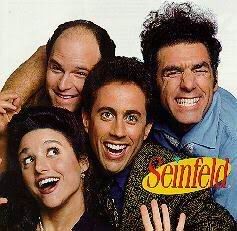
My Seinfeld Script: “Mr. Subliminal”

In 1998, I wrote this Seinfeld script one night out of the blue. Since today is Story Tuesday, enjoy!

TITLE: Mr. Subliminal

ELAINE interviews a prospective job candidate and JERRY buys a silk undershirt.

Seinfeld

Scene I

JERRY at comedy club.

JERRY (on stage): You wanna know why I became a stand-up comedian?

All the other jobs had applications! – I couldn’t handle the applications. “Applying for a job? Please fill this short form out … High school athletics … past salaries … references.”

I didn’t have any of those. I would hand in a half-filled out application. The secretary would never even let me in to see the interviewer.

Scene II

In ELAINE’s office at work.

ALFRED GRUBERG (A medium-height, going bald, 30-45-year-old man. Dressed in a business suit for an interview. Smiling and charming. He has one quirk: he is a psychologist by training and often inserts subliminal phrases into his speech. Subliminal phrases are in all capital letters. Alfred says these phrases quickly as if skimming over the words with no change in demeanor, in how he speaks, how he acts.)

ELAINE and ALFRED walking in.

ELAINE: Mr. Gruberg, please sit down. (ELAINE points to seat on other side of her desk) Now, let’s take a look at your resume. … Secretary at Blomingdale’s . . . Vogue . . . Russian Tea Room. Psychology? It says here that you received a degree in psychology before starting your secretarial positions. Why would you do that (very puzzled look, taking her glasses off) – gain proficiency in one field and then leave it for secretarial positions?

ALFRED: Well let me tell you the two differences between secretaries and psychologists – Secretaries get fewer looney-tunes (signaling crazy with his finger to his head) if you know what I mean (smiles at ELAINE) GORGEOUS BRUNETTE WOMEN and more money to boot. (laughs, trying to get ELAINE to laugh with him)

ELAINE: (laughs uncomfortablly, looking at resume) Uh-huh.

ELAINE’s VOICEOVER: (Double-take) Did he just say “gorgeous brunette women”? Is he trying to come on to me during an interview?

ALFRED: (reaching over her desk) And if you notice there at the bottom, I have listed my specifications: typing speed LOOK CLOSELY PENILE ENLARGEMENT and standardized test scores.

ELAINE’s VOICEOVER: (ELAINE looks very skeptical) Standardized test scores?

Scene III

JERRY’s apartment. JERRY and GEORGE.

JERRY: My mom recommended I buy a silk undershirt for the winter. But I just don’t know . . . . She recommends it every year.

GEORGE: Oh, no, JERRY, silk undershirts have been underrated. My mom got me a bunch when I was in junior high school.

JERRY: And you still have them?

GEORGE: Uh-huh.

JERRY: You have silk undershirts from when you were in junior high?!?! How could they have lasted that long?

GEORGE: (Looking at himself apologetically) Well, I haven’t changed much. (Explanatory tone) And – and I only wear them in the winter.

KRAMER walks in.

JERRY: Hey, Kramer, you have any silk undershirts?

KRAMER: Oh, yeah, (smiling big) how else do you think I stay warm in the winter? And let me tell you, women love that! Silk shirts, silk boxers, silk bedsheets, oh yeah! Ok, guys, I need your advice.

(Door buzzer)

Continue reading “My Seinfeld Script: “Mr. Subliminal””

Let’s Talk about Games

Let’s talk about games.

That’s already an oxymoron on some levels! The point of games is to play them, not to talk about them. Still, why are games so hot? Why am I so big on games? You’ve seen me write about games. You’ve seen me talk about the feeling of being alive when you’re playing games.

WHAT IS IT ABOUT GAMES?

  • The Thrill
  • The Competition
  • The Speed
  • The Creativity Needed to Win
  • Winning
  • Possibility of Affecting the Outcome
  • Not Knowing Until the End
  • Knowledge of Possibly Improving Each Time

I can tell you all these above, and yet. And yet! Those are WORDS! As Hamlet says, “Words, words, words!” There’s no point for words. Games are about action!

You think you can smack-talk your opponent? Go ahead, but let’s see if your skill holds up to your smack-talk. Larry Bird was always known for his smack-talk, and maybe priming his opponents for failure was EXACTLY what he was going for because it may have worked (so suggests the latest research). But even better, Bird’s skill ALWAYS held up on the court. ALWAYS.

Games are about using our best self to beat the competition.

EVER USE A GAME AT WORK?

Have you? Sure you have! Everytime you’re on deadline and you need to make a specific time. Everytime you want to complete something faster than you did it last time. Everytime you want this quarter to be better than last quarter. Everytime you count how many clients your company has. You’re always playing games.

But sometimes they feel like work. What would make those same games that you are right now not calling games and are possibly not considering as fun – what would make those games fun and productive for you and improve business for the company?

Sure, I know that’s a leading, rhetorical question…

I refer you to my favorite Simpsons quote of all time:

Lisa: Dad, do you even know what “rhetorical” means?

Homer: Do *I* know what “rhetorical” means?

FUN, PRODUCTIVE, IMPROVES BUSINESS

Look, I’m not advocating going crazy with happiness juice, and just saying blindly, “Oh, let’s turn our work into fun.” I’m advocating asking yourself or your colleagues, “How can I get more of these components into my work?”

  • The Thrill
  • The Competition
  • The Speed
  • The Creativity Needed to Win
  • Winning
  • Possibility of Affecting the Outcome
  • Not Knowing Until the End
  • Knowledge of Possibly Improving Each Time

Remember, being wealthy is about having money and time. How can you enjoy your time at work more, leave more time for yourself outside of work, and show that “play” can get improved results? How can you put those elements in, and put them in in such a way that they improve the bottom line?

I know I’ve asked more questions above than I’ve answered. This week and next week, I’ll be writing a lot about GAMES and BUSINESS!

And today, I’m asking you: how do you think you could make work more like “play” and do so in a way that strengthens the bottom line?

In-the-news: March 19, 2007

Links to wonderful things!

  • Fastest Memory-Jogger: Happiness project. Keeping a one-sentence daily journal. I really like this post from Gretchen. There’s also a company that lets you text message from your cell phone a photo each day or some text each day, and then they build a timeline of your life! I’m a big fan of this idea – see nowthen.com.
  • Brain Tests on TV: SharpBrains site. Video of the Founder on CBS describing two great brain tests. See how you fare! See other wonderful brain exercises on this site here.
  • Definitions of Happiness: Boston Herald (AP). It’s hard to define happiness – therein lies its appeal. About Darrin McMahon, author of “Happiness: A History,” one of NYTimes’ 100 books of 2006. Some definitions of happiness in his book: luck (“Happiness is linked to such words as happen and happenstance.”), feeling good, looking back on a good life, virtue, pleasure. McMahon says, ” “I wish I could tell you that having studied the history of happiness for six years I’ve got the magic bullet, but I don’t,” he said. ”I just go about my business and find that happiness will come to me.” “
  • Drugs to Keep You Alert?: Nootrops (smart drugs) blog. Senia note: How bizarre!! Messing with our minds. Can taking a drug to increase alertness and fast thinking become in the future as simple as a cup of coffee?
  • Ask Questions!: The Practice of Leadership blog. Super book recommendation: “Change Your Questions, Change Your Life: 7 Powerful Tools for Life and Work” by Marilee Adams (changeyourquestions.com).

QUESTION FRIDAY: How do you celebrate steps towards a goal?

This week, we talked about the exponential power of daily action and taking daily action steps to gain the 10,000 hours of expertise!

Question: When you’re working toward a goal, how do you celebrate the steps along the way to that goal?

celebrate

Here, on Positive Psychology News Daily, Nicholas Hall gives a summary of some ways to celebrate steps. He breaks out possible celebrations along two axes: body-mind-spirit and pleasure-engagement-meaning. Some suggestions:

  • Go dancing (Body and Engagement)
  • Learn something you’ve always wanted to (Mind and Meaning)
  • talk to a friend (Mind and Engagement)

What is your list of small celebrations?!
Thanks!
Great weekend!

I’d love to hear your answers. Feel free to leave anonymous comments. My answers are in the comments also.
Image: fireworks.