“Living well and beautifully and justly are all one thing.”
~ Socrates
I was just thinking about that this week.
Chief People Officer partnering with CEOs/executives to help them WIN their next, ideal role
“Living well and beautifully and justly are all one thing.”
~ Socrates
I was just thinking about that this week.
This is the first year in my life that I’ve ever carved pumpkins! Mine’s the one in the front. I really like my friend’s scary one in the back too – especially the teeth and dennis-the-menace hair! :)

Hi, it’s Friday, the play and ask questions day.
What are your favorite things about the fall?!?!?
Some of mine:
* The smell of leaves
* The COLOR of leaves
* Ice cream – I know it’s possible at any time of year, but now there are these flavors: pumpkin, chestnut, later eggnog. :)
* THE WIND!!!! Great wind in the fall, and usually not too cool yet.
* Good time to get together with friends … going inside into cozy places.
…. and your favorite things about the fall?
Today is an incredible, historic, wonderful day for women in chess!
Judit Polgar beats Veselin Topalov. Topalov is the highest ranked chess player in the world. He was the FIFE World Chess Champion for 2005. This is the first time that a woman has ever beaten the highest ranked player. Topalov’s chess rating has been at 2890, and is currently 2813. Polger’s chess rating is currently 2710.
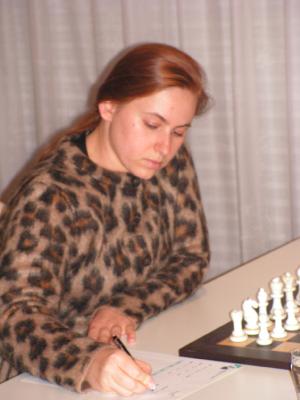
The Essent Chess Tournament 2006 is currently going on (Oct 20-28). (The site is mainly not in English, but the chess moves, photos, and standings are quite readable. Judit is in the Crown Group.) In this tournament (today’s news), Judit Polgar, 30, beat Veselin Topalov, 31. There are six rounds in the tournament, and so far, Polgar is winning the first two rounds!
To watch the winning game, click here. Then hit the play button “>” to watch each move. Judit plays white. It is incredible to me that in her moves 16-17 and 26-27 are both two-part moves to accomplish something – that she is calm enough to move her pieces in time to where she wants them to be. Try to guess move 26 before she makes it. The commentators say this was her winning move. Pause at move 25 and see what you think.
Links:
* She is a mother of two, and returned to chess in January ’06 after a fifteen-month maternity leave.
* Judit Polgar wikipedia entry.
* The chess games of Judit Polgar.
* Some photos of Judit.
* I wrote about the Polgar family before here (specifically her father and how he trained his three daughters, the youngest of which, Judit, is the most successful in chess).
* Brief bio from chessgames.com, “Judit Polgar was born in Hungary in 1976. Her childhood consisted of an extensive chess education from her father and her sisters, and she began to compete internationally as early as 1984. In 1991 she became an International Grandmaster by winning the “men’s” Hungarian championship. At fifteen years and five months of age, she was the youngest grandmaster in history, breaking a record that Robert James Fischer had held for over 30 years. She has been the highest-rated woman ever since FIDE’s January 1990 list, and in 2003 she entered the overall top ten.”
* Judit’s sister Susan Polgar runs a Chess Center in NY and has an active and very interesting blog.
You’re buying lunch for a group of people, and the man at the counter says, $22.11. But you know the total is $42.11. You say, “Um, excuse me, it’s $20 more.” He says, “Oh, let me see – oh, thank you, that’s great! That’s great. Thank you.”
And you stand at the counter among the chips and the chewing gum while he rings your credit card through again. And you mumble to yourself, “It’s hard to be good.”
…”What?” he actually heard you. “You mean it’s hard to not eat the chocolate bars we have here? Oh, come on, get it anyway, don’t worry, you’re not being bad!”
I says, “Thanks, bye,” and I leave. I wasn’t talking about any chocolate bar. I was talking about how it’s hard to put yourself in a position of rightness when being unright is easy. And there are many situations where being unright is easy and being right is not easy. Returning the shopping cart to the shopping cart drop-off. Not being bad to your body, and instead eating healthily. Not taking your temper out on people you know well, but curbing it, or announcing, I have a temper, and I’m not going to speak loudly right now, or it’ll run away. Doing exercise. Taking time for yourself instead of overburdening. Finishing all the most important priorities first. Not giving in to excesses, like drinking, eating, smoking, etc.
All of us know that those things are GOOD. But are they necessary?
Maybe they are.
Why might they be necessary? The good things. The this-can-be-helpful and this-is-a-strong-should things. They could be necessary for two reasons:
1) The Universe Knows. The universe knows when things are right and things are good. The universe knows when you are clean and right and good. The universe knows when you have justice, truth, peace, beauty, and accountability on your side. The universe knows.
2) Aristotle says, “Do good.” Aristotle makes a multi-part argument about the goal of people, how people desire to reach the highest good, how people can achieve that highest good for themselves, and what the highest good must be for mankind.
Here is the summary of Aristotle’s thoughts:
* The highest human good – the underlying reason why people do anything (if you peel back enough layers) – is happiness, the desire for happiness.
* There are many definitions of happiness (pleasure, virtue, study), but most people agree even within happiness there is a highest possible type of good that would would be universal and single and would subsume the other goods.
* What is that highest possible type of good?
* (This part added by me: if you look at a knife, the best it can do is to be the best kind of knife – sharp, precise, the best qualities of the knife). If you look at a flutist, says Aristotle, then his highest good is to be the best possible flutist. For a craftsperson, to be the best possible craftsperson. And what about for a human?
* Aristotle says, it is to be the best possible human! And to be the best possible human, a person needs to seek goodness – to do good things, to do virtuous things – because those are the highest, best possible ways of being for a human.
Finally, similar to the idea of “the universe knows,” Aristotle says, “Happiness is acquired by virtue, and hence by our own actions, not by fortune.”
Aristotle starts his second chapter by instructing how to achieve virtue, and then from that, happiness: “Virtues … we acquire, just as we acquire crafts, by having previous activated them.” Thus Aristotle instructs us on having good habits. “So also, then, we become just by doing just actions, temperate by doing temperate actions, brave by doing brave actions.”
Therefore, doing good makes us good which is the highest thing a human being can do, and thus this will in the long run make us happiest.
Recommended Reading: Nichomachean Ethics and Leadership and Self-Deception.
Note: More to come on this topic.
“I am always doing that which I can not do, in order that I may learn how to do it.”
~ Pablo Picasso
Here is the summary of September, 2006.
Hello to the start of autumn.
My favorite entry from September is Today is Everyday.
BTW, my October resolution is to write every weekday (like Fred says) and to have a new post (even if it’s a mini-post every M-F)
Thoughts and Recommendations
Sharpbrains Blog!, When Is Intuition Different From a First Thought? (more on this topic in Oct, Nov!), Missing Mondays, Wednesday, Life Moves Forward
Regularly-Scheduled Fun Stuff :)
See you MUCH MORE in October! Enjoy the outdoors – it’s probably early autumn or early spring wherever you are!
Senia
When a person stops thinking about one thing and starts thinking about something else, often the switch in thoughts is triggered by an emotion. Specifically, moving from one thought to another can be described as removing one thought from conscious thinking, and replacing it with another thought into conscious thinking.
Why do you start thinking a new thought? Why does a new thought move into your conscious thinking? It might be that you start thinking a new thought because you touch, see, and hear something (Damasio (1999)), because you have a feeling and that triggers this thought (Damasio), because you have a thought that triggers this thought (Damasio & LeDoux (1996)), or because you become for an instant more self-awareness (LeDoux). And there are probably even more other stimuli that may trigger a new thought.
I’m interested in looking at emotions as triggering a thought moving into conscious thinking. Part of Merriam-Webster’s definition of emotion is that it is “subjectively experienced as a strong feeling . . . typically accompanied by physiological and behavioral changes in the body.†An emotion is a set of sensations.
How can emotions trigger thoughts? Not every emotion has to trigger a change in thought. For example, a person can have three different emotions while thinking about the same topic, but on the fourth emotion, the person may switch to thinking about a different topic.
What is the basis for the assumption that emotions can trigger thoughts?
In summary, various research points to the assumption that feelings often trigger thoughts – the biological explanation, the Ekman explanation of emotions motivating behavior, and the Haidt research pointing to initial reactions being motivated by feelings ahead of thoughts.
More to come later this week and next!
References:
Damasio, A. (1999). The Feeling of What Happens. San Diego: Harcourt, Inc.
Ekman, P. (2003). Emotions Revealed. New York: Henry Holt and Company.
Goldberg, E. (2005). The Wisdom Paradox. New York: Gotham Books.
Haidt, J. (2006). The Happiness Hypothesis. New York: Basic Books.
LeDoux, J. (1996). The Emotional Brain. New York: Simon and Schuster.
Myers, D. (2002). Intuition: Its Power and Perils. New Haven: Yale University Press.
“As a single footstep will not make a path on the earth, so a
single thought will not make a pathway in the mind. To make a deep
physical path, we walk again and again. To make a deep mental path,
we must think over and over the kind of thoughts we wish to
dominate our lives.”
~ Henry David Thoreau